Comprehensive testosterone blood test

Your testosterone,
in context.

One blood draw from your arm checks 45 markers. Your clinician explains the results in your Heracles account.

Choose where to testExplore the 45 markers
Heracles Venous Blood Collection Kit with three sample tubes and a butterfly collection set
CQC-registered clinic
GPhC-registered pharmacy
Viva Health Labs
Free UK test delivery

When is a wider test useful?

This panel can follow a low or borderline testosterone result or help monitor TRT.

Explore the finger-prick test

Where would you like
your blood taken?

Both prices include the kit, professional blood draw, lab analysis and clinician-reviewed report.

Superdrug

At a clinic

Bring your kit to a participating Superdrug clinic.

£84.99 one-off

Heim

At home

Book a qualified nurse’s home visit at least 48 hours ahead.

£109.99 one-off

What’s included

45 markers, including calculated results.

Prostate-specific antigen (PSA)
Additional health markers

PSA is a protein made by the prostate. A change can have several causes and does not diagnose cancer on its own, but it can show when follow-up may be useful.

HbA1c
Additional health markers

HbA1c reflects your average blood-sugar level over roughly the last two to three months. It helps identify prediabetes or diabetes and track longer-term glucose control.

Ferritin
Blood cells & iron

Ferritin is the main marker of your stored iron. A low result can help explain iron-deficiency anaemia and tiredness; a high result needs context because inflammation can also raise it.

Mean platelet volume (MPV)
Blood cells & iron

MPV shows the average size of your platelets. Read with the platelet count, it gives clues about how quickly platelets are being produced and replaced.

Platelet count
Blood cells & iron

Platelets help your blood clot after an injury. The count helps identify whether there may be an increased tendency to bleed or form clots.

Neutrophil count
Blood cells & iron

This is the actual number of neutrophils in your blood. It can change with infection, inflammation, medicines or bone-marrow activity.

Neutrophil percentage
Blood cells & iron

This shows what share of your white blood cells are neutrophils, the immune system's rapid-response cells. It is most useful when read with the actual neutrophil count.

Lymphocyte count
Blood cells & iron

This is the actual number of lymphocytes in your blood. It helps assess how your immune system is responding to infection or other health changes.

Lymphocyte percentage
Blood cells & iron

This shows what share of your white blood cells are lymphocytes, which help fight viruses and build immune memory. It is most useful when read with the actual lymphocyte count.

White blood cell count
Blood cells & iron

This is the total number of cells involved in your immune response. A high or low result can add context on infection, inflammation, medicines or immune health.

Red cell distribution width (RDW-CV)
Blood cells & iron

RDW shows how much your red blood cells vary in size. A wider spread can provide an early clue to iron, B12 or folate-related anaemia.

Mean corpuscular haemoglobin concentration (MCHC)
Blood cells & iron

MCHC shows how concentrated the haemoglobin is inside your red blood cells. Alongside MCV and MCH, it helps identify patterns of anaemia.

Mean corpuscular haemoglobin (MCH)
Blood cells & iron

MCH shows how much oxygen-carrying haemoglobin is in each red blood cell. It helps add detail when investigating anaemia.

Mean cell volume (MCV)
Blood cells & iron

MCV shows the average size of your red blood cells. It helps narrow down different types and possible causes of anaemia.

Haematocrit
Blood cells & iron

Haematocrit shows how much of your blood is made up of red cells. It helps assess anaemia, hydration and whether testosterone treatment is raising red-cell levels too far.

Haemoglobin
Blood cells & iron

Haemoglobin is the protein in red blood cells that carries oxygen. A low level can point towards anaemia and may help explain tiredness, weakness or breathlessness.

Red blood cell count
Blood cells & iron

This counts the red blood cells that carry oxygen around your body. Too few can support a diagnosis of anaemia; a high result may need context from hydration and other markers.

Estimated glomerular filtration rate (eGFR)
Kidney & electrolytes

eGFR estimates how well your kidneys are filtering blood. Tracking it over time can reveal changes that a single result may not show.

Creatinine
Kidney & electrolytes

Creatinine is a waste product from normal muscle activity. Because the kidneys clear it from the blood, it helps estimate how well they are filtering.

Urea
Kidney & electrolytes

Urea is a waste product made when your body breaks down protein. It can rise with dehydration or reduced kidney clearance, so it is read with creatinine and eGFR.

Chloride
Kidney & electrolytes

Chloride works with sodium and bicarbonate to balance fluid and acidity. It helps make sense of hydration, kidney function and other electrolyte results.

Sodium
Kidney & electrolytes

Sodium helps control fluid balance, nerves and blood pressure. An unusual level can reflect hydration, kidney function, medicines or hormone changes.

Globulin
Liver health

Globulins are a group of proteins involved in immunity and carrying substances through the blood. An unusual result can add context on inflammation, immune activity or liver health.

Gamma-glutamyl transferase (GGT)
Liver health

GGT is an enzyme linked with the liver and bile ducts. It can help clarify other liver results and may change with alcohol, medicines or liver irritation.

Total protein
Liver health

This measures the main proteins in your blood: albumin and globulins. It adds context on liver function, nutrition, inflammation and immune activity.

Alkaline phosphatase (ALP)
Liver health

ALP is an enzyme linked with the liver, bile ducts and bones. If it is raised, the wider panel helps show which of those areas may need a closer look.

Aspartate aminotransferase (AST)
Liver health

AST is an enzyme found in the liver and muscles. Comparing it with ALT helps give context on whether a change may be coming from the liver or elsewhere.

Alanine transaminase (ALT)
Liver health

ALT is an enzyme found mainly in liver cells. A rise can be a sign that the liver is irritated, so it is read alongside the rest of your liver results.

Total bilirubin
Liver health

Bilirubin is a waste product made when old red blood cells are broken down. A raised result can point to changes in how the liver processes waste, bile flow or red-cell breakdown.

Total cholesterol-to-HDL ratio
Heart & cholesterol

This compares your total cholesterol with the protective HDL portion. It helps put the headline cholesterol number into context; a lower ratio is generally more favourable.

Triglycerides
Heart & cholesterol

Triglycerides are fats your body uses and stores for energy. Raised levels can be linked with diet, alcohol, weight and metabolic health, and can add to heart risk.

Non-HDL cholesterol
Heart & cholesterol

This combines LDL with the other types of cholesterol that can contribute to blocked arteries. It gives a broader view of heart risk than LDL alone.

LDL cholesterol
Heart & cholesterol

LDL carries cholesterol around the body. Too much can build up in artery walls, so it is an important part of understanding heart risk.

HDL cholesterol
Heart & cholesterol

HDL helps carry cholesterol away from the arteries and back to the liver. Higher levels are generally linked with lower heart and circulation risk.

Total cholesterol
Heart & cholesterol

This is the total amount of cholesterol carried in your blood. It gives a useful overview, but the HDL, LDL and non-HDL results show more about heart risk.

Free T4
Hormones & fertility

Free T4 is the thyroid hormone available for your body to use. Read with TSH, it helps show whether your thyroid is underactive or overactive.

Thyroid-stimulating hormone (TSH)
Hormones & fertility

TSH tells your thyroid how hard to work. Thyroid problems can affect energy, weight, mood and sex drive, so this helps rule in or out another cause of symptoms.

Oestradiol
Hormones & fertility

Oestradiol is an oestrogen that men make partly from testosterone. The right balance supports bone and sexual health, while unusually high or low levels can add context to symptoms.

Prolactin
Hormones & fertility

Prolactin is made by the pituitary gland. When it is raised, it can interfere with testosterone, sex drive and erections, so it may help explain hormonal symptoms.

Follicle-stimulating hormone (FSH)
Hormones & fertility

FSH is a brain hormone involved in sperm production. It can help assess fertility and how well the testes are working.

Luteinising hormone (LH)
Hormones & fertility

LH is the brain's signal telling the testes to make testosterone. It helps show whether low testosterone may begin in the testes or in the signalling from the brain.

Albumin
Hormones & fertility

Albumin is another protein that carries testosterone. We use it with total testosterone and SHBG to estimate your free testosterone more accurately.

SHBG
Hormones & fertility

SHBG is a protein that carries testosterone in your blood. Its level affects how much testosterone is left available for your body to use.

Free testosterone
Hormones & fertility

This estimates the testosterone that is available for your body to use. It can add useful context when your total testosterone does not match how you feel.

Total testosterone
Hormones & fertility

This shows how much testosterone is in your blood overall. It helps assess whether symptoms such as low sex drive, tiredness or loss of strength could be linked to low testosterone.

Thank you! Your submission has been received!
Oops! Something went wrong while submitting the form.

From kit to results.

  1. Order your kit

    Choose clinic or home collection. We post your kit.

  2. Book your blood draw

    Follow the kit’s booking instructions and bring it to your appointment.

  3. Read your report

    Sign in for your results, clinician’s notes and follow-up advice.

Your blood results, explained.

See how your readings compare with the lab ranges.

View sample reportExample from the Heracles dashboard using fictional results.
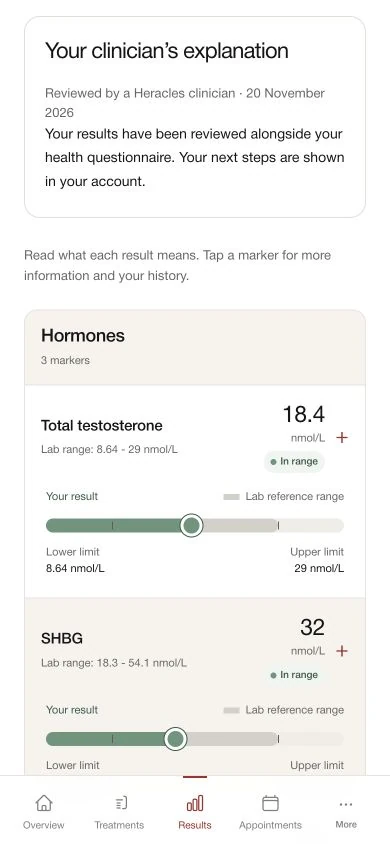

Example of a Heracles patient dashboard blood report

Could TRT be right for me?

Review your report with your doctor.

  1. Meet your doctor

    Discuss symptoms, results and fertility plans by video.

  2. Confirm a low result

    Your doctor checks for low testosterone on two separate mornings.

  3. Agree on next steps

    Decide together whether TRT is right for you.

See blood test collection options

The specialists behind Heracles.

Professors Tet Yap and Suks Minhas founded Heracles.

Meet the clinical team

Professor Tet YapProfessor of UrologyKing’s College LondonProfessor Suks MinhasConsultant Urologist and AndrologistImperial College Healthcare NHS Trust

What people say
about Heracles.

Read more on Trustpilot
★★★★★

“Switching providers felt like a big decision, but Heracles made the process straightforward and reassuring.”

Josh HagenRead review
★★★★★

“What has impressed me most is the ongoing care and professionalism of the Heracles team.”

Wayne WilliamsRead review
★★★★★

“The level of service has been exceptional from start to finish.”

ClarkeRead review

Your questions,
answered.

How does this differ from the home finger-prick test?

The simple home test reports four markers. This panel uses blood taken from a vein to report 45 markers and calculated results, including hormones, cholesterol and blood counts.

Can I order it separately from TRT?

Yes. If you have a Heracles care plan, ask your team which tests it covers.

How should I prepare?

Follow your booking’s timing and preparation instructions. Tell the collection team about medicines and supplements.

Does a low result mean I need TRT?

Your clinician reviews your symptoms, medical history and results before discussing further tests or treatment.

Where can I see the full list of markers?

Explore the panel by health area or search for an individual marker. Select its name to see what it measures.

45 MARKERS · CLINIC OR HOME

Comprehensive blood test.

Hormones, thyroid, cholesterol, blood count and more.

From £84.99 · clinic collection included

Every result reviewed by a Heracles clinician.
CQC-regulated
Registered Pharmacy
UKAS-accredited laboratory
Plain, unbranded packaging
CQC-regulated
Registered Pharmacy
UKAS-accredited laboratory
Plain, unbranded packaging
CQC-regulated
Registered Pharmacy
UKAS-accredited laboratory
Plain, unbranded packaging
CQC-regulated
Registered Pharmacy
UKAS-accredited laboratory
Plain, unbranded packaging
CQC-regulated
Registered Pharmacy
UKAS-accredited laboratory
Plain, unbranded packaging
CQC-regulated
Registered Pharmacy
UKAS-accredited laboratory
Plain, unbranded packaging
CQC-regulated
Registered Pharmacy
UKAS-accredited laboratory
Plain, unbranded packaging

Collection options

Kit, collection, lab analysis and clinician review included.

SUPERDRUG

At a clinic

£84.99 one-off

At a participating Superdrug clinic.

Choose clinic

Already a patient? Order in your account.

How it works

1

Order your kit

Choose clinic collection or a home nurse visit.

2

Book your appointment

Your kit arrives first, with booking instructions.

3

View your results

Your clinician-reviewed report appears in your Heracles account.

Your results

Reviewed by a clinician, with guidance on what to do next.

How to read your results ↗

Our clinical team

The expertise behind your care

Prof. Tet Yap
Co-Founder · Professor of Urology, King's College London
Meet Tet →
Prof. Suks Minhas
Co-Founder & Chief Medical Officer · Consultant Urologist and Andrologist
Meet Suks →
Mr Peter Grice
Clinical Lead, Consultant Andrologist & Urologist, Imperial
Meet Peter →
Dr. Ian Gallen, CBE
 Consultant Endocrinologist · Medical Advisor, London 2012 Olympics
Meet Ian →
Dr. Vinit K. Shah
Consultant in Endocrinology, Diabetes & Internal Medicine
Meet Vinit →
Dr. Richie Kirwan, PhD RNutr
Senior Lecturer · Published research on nutrition, exercise and muscle health
Meet Richie →
Paula Allchorne
Urological Nurse & Psychosexual Therapist
Meet Paula →

Testimonials

What people say about Heracles

The difference was obvious from the first conversation.

Josh Hagen
Read review

What has impressed me most is the ongoing care and professionalism of the Heracles team.

Wayne Williams
Read review

The health expert I was given was absolutely fantastic and has really made my own health journey so much easier.

My experience with Heracles has been excellent from start to finish.

Lukeybaby
Read review

FAQs

What is a comprehensive testosterone blood test?

The Comprehensive Blood Test is a 45-entry venous panel that puts testosterone into wider health context. It covers hormones, thyroid, blood count, liver, kidneys, cholesterol, blood sugar, iron stores and total PSA.Source: EAU Male Hypogonadism Guideline.

What does the comprehensive panel include?

It includes total and calculated free testosterone, SHBG, LH, FSH, oestradiol and prolactin, plus TSH, FT4, 14 blood-count entries, eight liver markers, five kidney and electrolyte markers, six cholesterol results, HbA1c, ferritin and total PSA. Counts include calculated results and blood-count percentages.Source: EAU Male Hypogonadism Guideline.

Why does this test use a venous blood sample?

A professional takes a venous sample to provide enough blood for this wider panel. The four-marker finger-prick test remains an option for an initial testosterone check.

Do I need a referral or an initial testosterone test first?

You can buy this test as a standalone service. If you are already following a Heracles assessment or treatment plan, order through your account so your test stays linked to your care. A test purchase does not replace a clinical assessment or guarantee treatment.

Who is the Comprehensive Testosterone Check for?

It may suit men who want a detailed hormonal baseline, are investigating symptoms associated with low testosterone, need to confirm an earlier result or require wider blood monitoring. A blood test does not diagnose testosterone deficiency by itself.Source: EAU Male Hypogonadism Guideline.

When should my testosterone blood sample be taken?

For assessment of testosterone, follow the morning sampling and preparation instructions from the clinical team and your kit. If you use testosterone treatment, follow the timing advised for your formulation. Ask the team if you are unsure.Source: EAU Male Hypogonadism Guideline.

How should I prepare for the blood test?

Follow the instructions sent before your appointment and stay well hydrated. Tell the clinical team about medicines and supplements you take, but do not stop prescribed medication unless a clinician tells you to. If you are acutely unwell, ask whether the test should be rearranged.Source: EAU Male Hypogonadism Guideline.

How do clinic collection and home visits work?

Your kit is delivered first. For clinic collection, use the QR code in the kit to book a participating Superdrug clinic and take the kit to your appointment. For a home visit, book through Heim at least 48 hours ahead and keep your kit ready. Follow the kit and appointment instructions for preparation and sample return.

Who reviews my testosterone blood test results?

A specialist clinician reviews the biomarkers together and explains them in context. This is important because an isolated result may mean something different when considered alongside your symptoms, medical history and other markers.Source: EAU Male Hypogonadism Guideline.

Does a low testosterone result mean I need TRT?

No. Testosterone replacement therapy should not be started from one low result alone. Diagnosis generally requires relevant symptoms and low morning testosterone confirmed on at least two occasions. Your wider health and fertility plans must also be considered.Source: Endocrine Society Testosterone Therapy Guideline.

What is the difference between this test and the finger-prick testosterone test?

The at-home finger-prick test measures total testosterone, free testosterone, SHBG and albumin. This comprehensive test uses a professionally collected venous sample for 45 markers and calculated results. Both include laboratory analysis and clinician review.

Can I use this blood test to monitor TRT?

Yes, when advised by your clinician. If blood monitoring is included in your Heracles plan, use your account to check your due test before buying separately. Follow your monitoring instructions and do not change your dose based on the results alone.Source: Endocrine Society Testosterone Therapy Guideline.