PSA understood over time. One at-home test every three months or six months, with every result reviewed and clearly explained by a specialist.
PSA monitoring · clinician-reviewed results
One test every three or six months · specialist review


Why regular testing matters
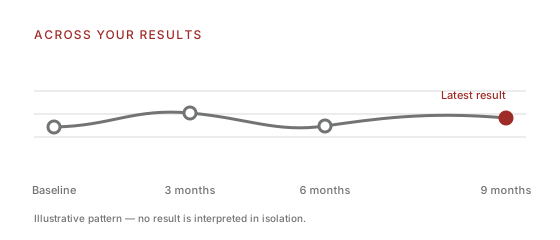
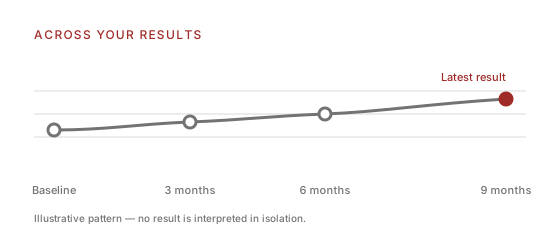
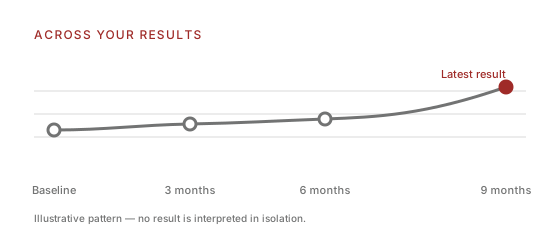
A single result gives you a starting point. Regular testing builds your own record, making it easier to see what has changed and understand your result.




Before you test
PSA can help identify changes in your prostate health. It cannot diagnose cancer by itself, so your result is reviewed alongside your age, health history and previous results.
PSA can rise for reasons other than cancer, including an enlarged prostate, infection, ejaculation and vigorous exercise. We ask a few questions first so your result can be interpreted properly.
Avoid ejaculation, anal sex, cycling and vigorous exercise for 48 hours beforehand.
If you have recently had a urine infection or prostate procedure, tell us before testing.
A raised result does not necessarily mean cancer. A clinician will review it and may suggest repeating the test, speaking to your GP or arranging further investigation privately.
Your first test, a family history or a previous result can all become a useful baseline.
Find My Baseline

How monitoring works
Your kit arrives every three or six months, depending on your monitoring schedule. After a stable first year, testing moves to once a year.
Answer a few questions
Tell us about your health, history and any previous PSA results.
Your kit arrives
Your finger-prick test is delivered when it is due.
Test and return
Take your sample at home and post it back.
Reviewed by a doctor
Your result is explained and compared with your previous tests.
Your schedule adapts
Stable results move to annual testing. If something changes, further investigation is available.
Understanding your results

URINARY CHANGES
Urinary changes can be worrying, but they are often caused by something other than prostate cancer. Your PSA check includes a short questionnaire that gives you an IPSS score—and, if needed, a route to speak with a urologist.

THE CLINICAL NAME
WHAT LUTS FEELS LIKE
Going more often. Waking at night. A weaker stream, sudden urgency or feeling you have not fully emptied your bladder.
WHAT YOU CAN DO ABOUT IT
These symptoms are common and often treatable. A dedicated consultation can explore the cause and arrange treatment or further tests if needed.
Know when not to wait
If you cannot pass urine at all, or have urinary symptoms together with a high or very low temperature, shaking or chills, or pain in your lower abdomen or back, contact your GP urgently or call 111 now.
Do not wait for your quiz result before seeking help.
suddenly become confused, very drowsy or have difficulty speaking;
have severe difficulty breathing;
develop new numbness around your genitals or bottom;
develop severe or worsening weakness or numbness in both legs; or
develop new loss of bladder or bowel control.
These symptoms need urgent assessment. This quiz cannot diagnose the cause.
Our clinical team



Health guides
PSA is a protein produced by the prostate. A blood test measures how much is present, giving your doctor information to interpret alongside your age, symptoms, history and previous results.
Your results will be ready to view in your dashboard once they've been processed by the laboratory and had clinician review. This normally takes 2-5 days.
No. PSA can also rise because of an enlarged prostate, inflammation, infection, recent ejaculation or vigorous exercise. A raised result is a reason to look more closely—not a cancer diagnosis.
One result provides a starting point. Repeating the test consistently builds a personal record, helping your doctor see whether your PSA is stable or whether a change deserves further review.
You can pause or cancel after your first testing cadence, whether that is three or six months.
Not necessarily. Its value depends on your age, symptoms, family history, genetic risk and previous results. You begin with a short health questionnaire so the service can be considered in the right context.
Your kit is initially delivered every three or six months, depending on your monitoring schedule. If your results remain stable through the first year, testing moves to once a year.
Your finger-prick kit arrives when your next test is due. Take the sample at home, return it in the supplied packaging and the laboratory analyses it. A doctor then reviews and explains the result.
The Heracles test uses a capillary blood sample analysed by UKAS-accredited Viva Health Laboratories. If a result needs confirmation, your doctor may recommend another finger-prick test or a venous sample before further decisions are made.
For 48 hours beforehand, avoid ejaculation, anal sex, vigorous exercise and cycling. Tell us if you have urinary symptoms, a recent urine infection, a recent prostate procedure or take medication that may affect PSA. If you have had a urine infection, testing may need to wait four to six weeks after it has cleared.
Your result is explained, added to your record and kept on the appropriate schedule. After a stable first year, monitoring ordinarily moves to once a year.
Your doctor considers the result alongside your previous tests, age, symptoms and history. The next step may be to repeat the test sooner, discuss it with your GP, seek a urologist’s opinion or consider imaging.
Yes. If imaging is clinically appropriate and you prefer to proceed privately, we can help arrange a prostate MRI through Scan.com. Scan.com offers bi-parametric and multiparametric prostate MRI at locations across the UK. Imaging is a separate service and its cost is explained before anything is arranged.
Yes. We can provide your results and a clear clinical summary to support a conversation with your GP. Your GP can then arrange an NHS referral or further investigation where appropriate.
Not by itself. An MRI produces detailed images and can identify areas that may need closer assessment. Depending on the findings, a specialist may recommend continued monitoring or further investigation such as a biopsy.
Going more often, getting up at night, a weaker stream or difficulty emptying your bladder are known as lower urinary tract symptoms. They are commonly caused by conditions other than cancer, and PSA cannot explain them on its own.
Do not wait for your next scheduled test if symptoms are new, persistent or worsening. A dedicated consultation and any additional investigations are available separately.
Your plan includes:
- Scheduled finger-prick kits
- Laboratory analysis
- Doctor review
- Your developing PSA record
- An explanation of every result
- Guidance on the appropriate next step
Private imaging, specialist consultations and additional investigations are charged separately and only arranged with your agreement.
Yes. Your results remain available in your record and can be shared with your GP or another clinician whenever you choose.
No. It provides an organised way to monitor PSA with clinical review. It does not replace an examination, urgent medical advice or any further investigation recommended by your doctor.